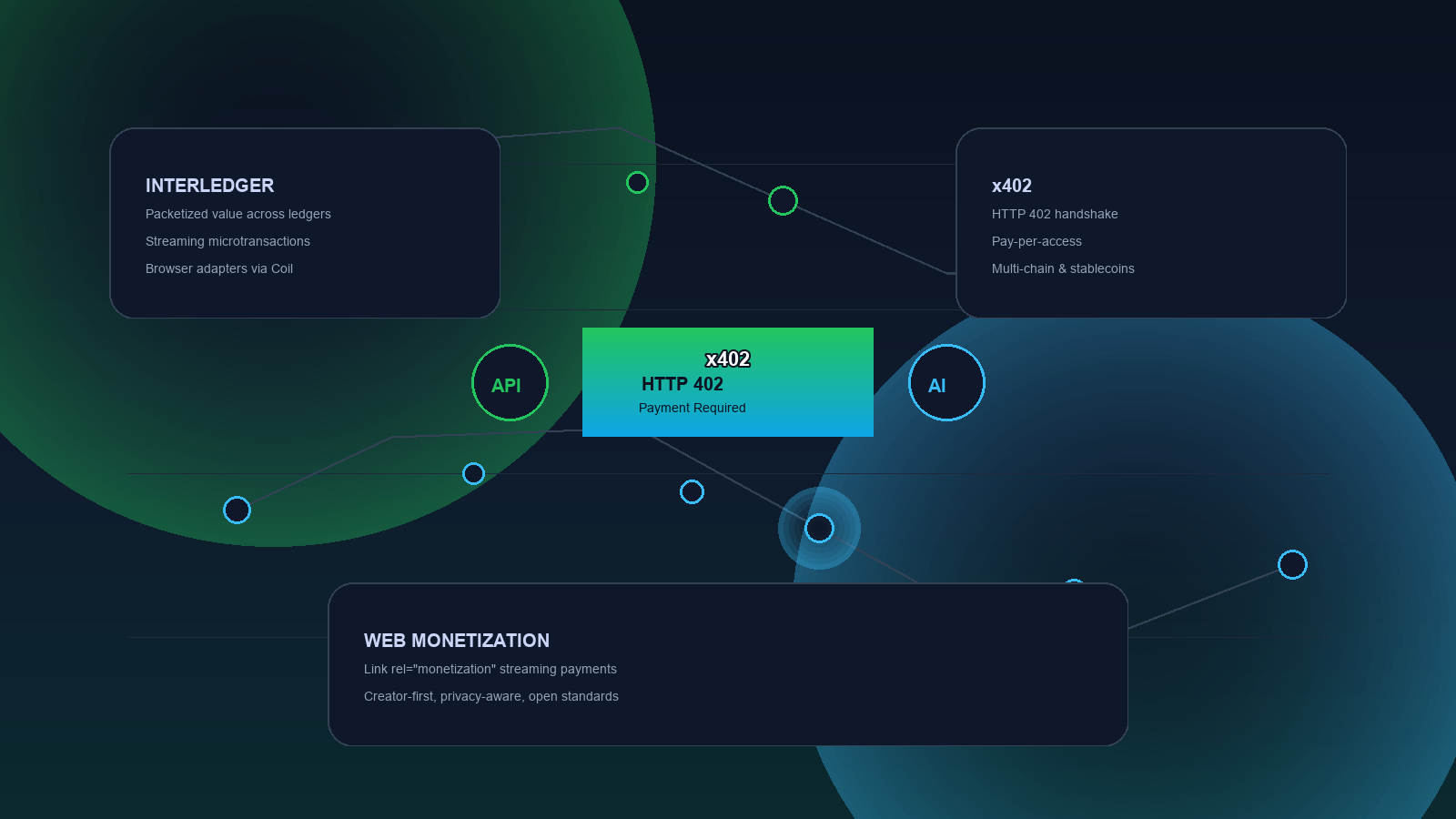
As the web evolves, so do the ways we fund content, compensate creators, and build business models around digital access. In this landscape, the emergence of x402 offers a compelling new chapter, one that extends the ambition of earlier standards like Interledger and Web Monetization while solving key limitations in scope, architecture, and adoption.
This post explores how x402 builds on the ideas behind Interledger and Web Monetization, highlights the innovations introduced by these earlier protocols, and compares x402 with other notable players such as Lightning Network, Brave Rewards, Unlock Protocol, and more.
Interledger and Web Monetization: A Bold Start
The Interledger Protocol (ILP) was designed to move value across different payment networks, much like how TCP/IP moves packets across diverse data networks. ILP introduced the idea of packetized money, where microtransactions could be routed through connectors regardless of currency or ledger type.
To bring ILP to the browser, the community introduced Web Monetization, a W3C draft that allowed a link rel="monetization" tag to stream tiny payments to a website using a payment pointer. Services like Coil acted as monetization providers, facilitating value transfer via ILP to creators with no ads, pop-ups, or paywalls.
What Worked
- Decentralized vision: ILP was ledger-agnostic and protocol-focused.
- Streaming model: Web Monetization enabled usage-based payment.
- Privacy-preserving: Minimal tracking and no ad-based surveillance.
What Didn't
- Limited adoption: only Coil supported it in practice.
- No native browser support: the W3C did not finalize the spec.
- Wallet friction: end users had few tools to manage monetization preferences.
Enter x402: A Modern Take on Monetized Access
Launched in 2024 and 2025, x402 turns HTTP 402 Payment Required into a real monetization handshake. Services return a 402 response with metadata about how to pay for access, allowing the client to send payment, receive an access token, and retry the request seamlessly.
Why x402 Is Different
- Multi-chain and stablecoin support across assets like ETH, USDC, and Solana.
- Access-first design focused on APIs, file downloads, and AI queries.
- Stateless and serverless-ready for machine-to-machine use cases.
- Developer-friendly integration into existing HTTP services.
x402 combines access gating with programmable payments without requiring full account signups or credit card forms.
Comparing Scope, Audience and Adoption
| Feature | Interledger / Web Monetization | x402 | Lightning + LSAT | Brave Rewards / BAT | Unlock Protocol |
|---|---|---|---|---|---|
| Design focus | Streaming micropayments | Per-request, pay-per-access | Instant crypto payments | Attention-based rewards | NFT memberships |
| Target audience | Web publishers, creators | API developers, AI services | Web devs, API providers | End users and creators | Web3-native creators |
| Payment layer | ILP (custom layer) | Web3, any chain | Bitcoin Lightning only | Ethereum (BAT) | Ethereum and Polygon NFTs |
| Browser integration | No, required Coil | Works with standard HTTP | Requires Lightning wallet | Brave-only | No, wallet required |
| Status and maturity | Experimental | Emerging, active | Niche but functional | Millions of users (Brave) | Growing in Web3 |
Shared Goals Across the Ecosystem
Despite architectural differences, these protocols all aim to solve the same foundational problem: the web lacks native support for monetization. Ads and subscriptions dominate, but frictionless per-use or streaming payment remains elusive.
- Granular value exchange: pay per use, per second, or per request.
- Creator empowerment: let content and service providers earn directly.
- User control: users decide who gets paid and when.
- Privacy-aware: avoid tracking-heavy models.
x402 stands out by working within existing web infrastructure while integrating with next-generation payment systems.
x402 in Context of Emerging Protocols
vs. Lightning and LSAT
LSAT pioneered the 402-as-payment-gate pattern but was tightly coupled to the Bitcoin Lightning Network. x402 generalizes the idea, supports more assets, and simplifies developer adoption with Web3 toolkits.
vs. Superfluid and Streaming Protocols
Superfluid and Sablier offer continuous on-chain streams but require wallets, gas fees, and balance maintenance. x402 is more practical for discrete actions like API calls or file access and can trigger streaming when needed.
vs. Unlock Protocol
Unlock uses NFTs as access keys, which works well for memberships but less so for dynamic metered access. x402 focuses on real-time payments for access, closer to metered APIs or one-time queries.
vs. Brave Rewards
Brave rewards users and creators inside a single browser via BAT but is not a web standard. x402, like Web Monetization, is an open protocol not tied to a single app or currency.
Final Thoughts: x402 as a Continuation, Not a Disruption
Rather than replace Interledger or Web Monetization, x402 builds on their legacy.
- It takes ILP's idea of value packets but uses modern crypto networks.
- It respects Web Monetization's goal of frictionless payments while aligning with real-world developer needs.
- It borrows from LSAT's integration of HTTP and crypto but makes it broader, simpler, and chain-agnostic.
As more services seek decentralized, usage-based revenue models, x402 offers a practical bridge between the monetization protocols of the past and the programmable money of the future.