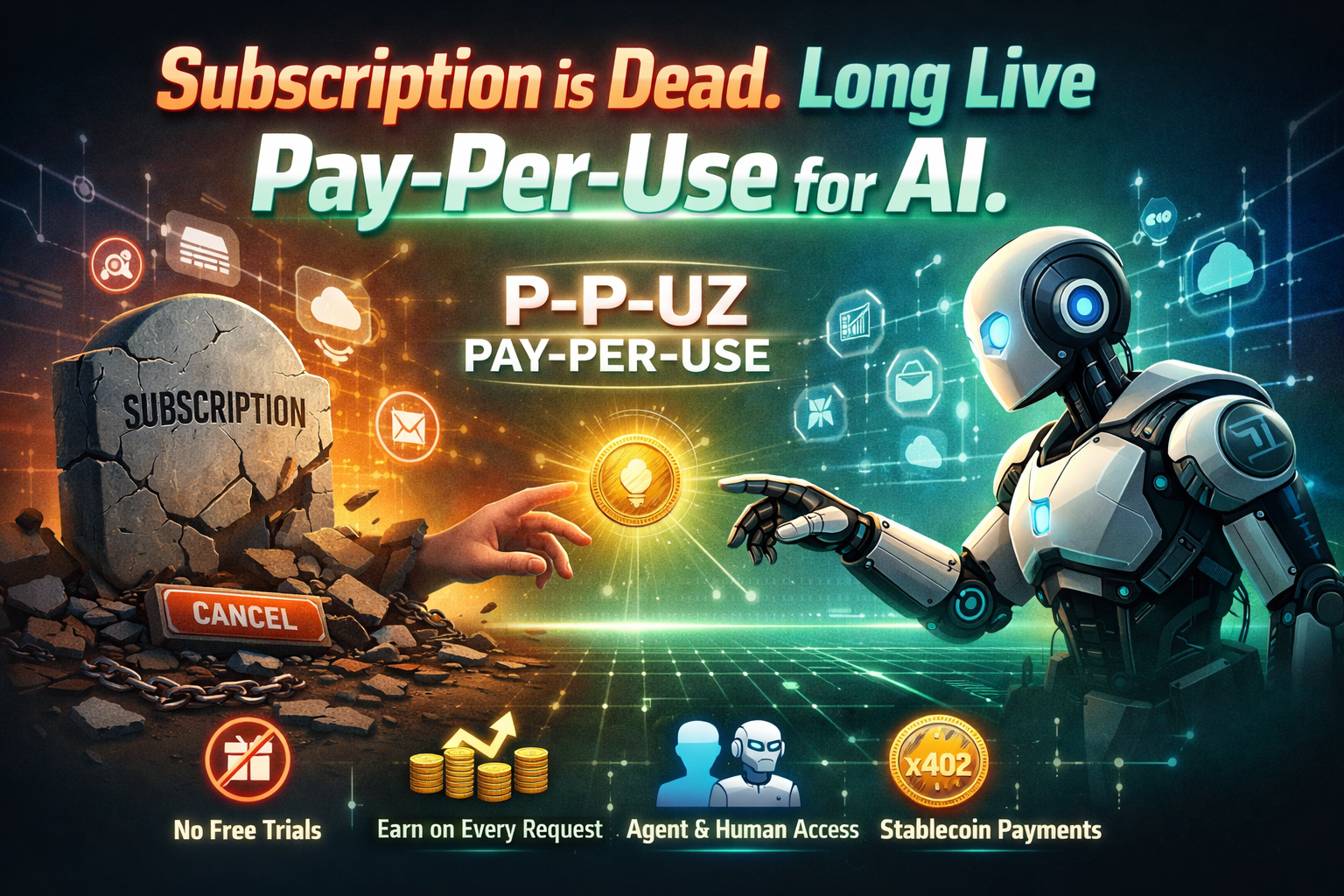
For a decade, subscriptions were the default business model for software. Stripe buttons, monthly plans, free trials, churn dashboards--this was the SaaS playbook. AI breaks that playbook.
Most AI products today are not full-stack platforms. They are layers of intelligence built on top of LLMs and model APIs: a chatbot for lawyers, a data-cleaning agent, a niche research assistant, a developer tool embedded inside another workflow. And yet, many of these products still try to monetize like Netflix. It is not working.
The Subscription Trap in AI
Subscription-based models rely on predictable, repeat usage and clear, ongoing value. AI products--especially niche AI tools--do not behave like that.
- Launch an AI app.
- Add a $10/month subscription.
- Nobody subscribes without trying it.
- Add free trials.
- Burn through tokens.
- Revenue stays near zero.
You end up paying for user acquisition with your OpenAI bill. Worse, billing infrastructure becomes more complex than the AI itself. For many emerging AI services, subscriptions are not just inefficient--they are structurally mismatched.
Why Subscriptions Fail Even Harder for Agentic AI
Agentic systems amplify the problem. An agent does not use one service. It orchestrates dozens: models, tools, APIs, retrieval systems, external services. Subscribing to every dependency is impossible--both technically and economically.
Agents need liquid access to services, not gated memberships. A future where agents negotiate tasks across the web cannot be built on monthly SaaS contracts.
Enter Pay-Per-Use (P-P-UZ)
At Agnic, we are launching a new monetization model we call Pay-Per-Use (P-P-UZ). Instead of subscriptions, every AI request becomes a micro-transaction.
Users pay for exactly what they consume. Builders earn on every request. No subscriptions. No trials. No billing code.
Agnic funds the first $5 of usage for every user, so builders get real usage without burning their own capital. Builders simply add their margin to each request--25%, 10%, 30%, whatever fits their value. Three headers. That is the entire integration.
Why P-P-UZ Changes the Growth Equation
- Zero acquisition cost: builders no longer subsidize free trials. Users explore with Agnic-funded credit.
- Revenue from day one: every request includes your margin. Even before users top up, you are earning.
- Transparent pricing: users see real per-request costs instead of arbitrary subscription tiers.
- Perfect fit for agents: agents can call services dynamically, paying per task without subscriptions.
The Human-Agent Payment Convergence
The deeper implication is not just business--it is infrastructure. In the future, humans and AI agents will access services through the same economic rails. A developer, a bot, or an autonomous agent should be able to invoke a service and settle payment instantly.
P-P-UZ is designed for that world. Protocols like x402 and stablecoin-based settlement systems point toward a programmable economy where APIs are paid in real time. AI services become composable economic primitives, not subscription silos.
A New Growth Engine for AI Services
Subscriptions optimized the SaaS era. Pay-Per-Use will optimize the AI era.
When every request is monetized, builders can focus on intelligence, not billing. When agents can pay autonomously, AI ecosystems can scale without human friction. When pricing is granular, innovation accelerates.
Subscription is not dead for everything. But for many AI wrappers, niche tools, and agentic services, it is already obsolete. The future of AI services is request-based, protocol-native, and economically composable. And P-P-UZ is one step toward that future.
Stop guessing pricing. Start earning per request.