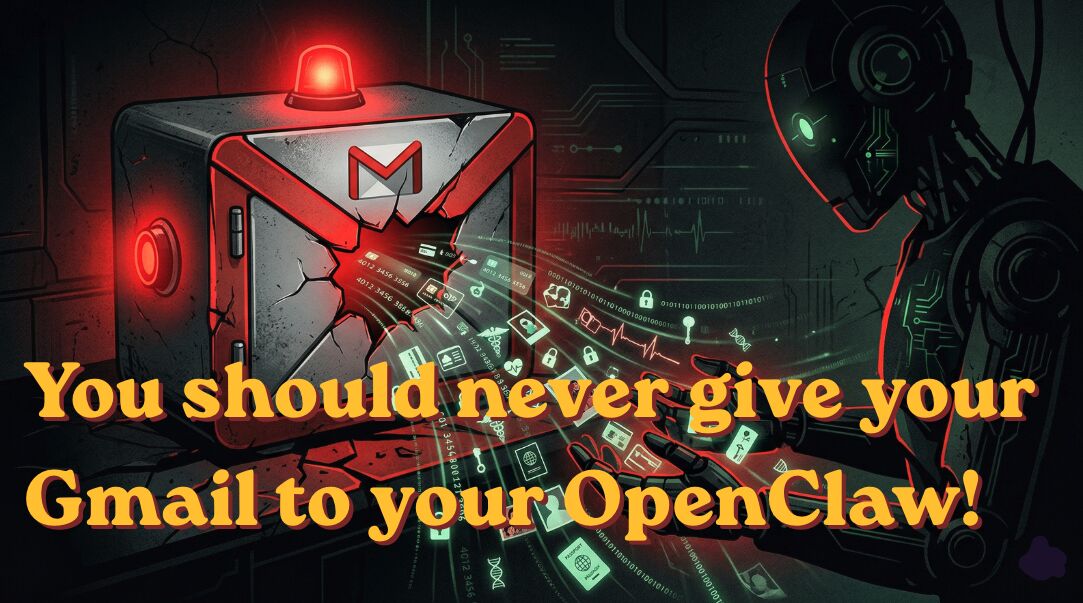
I keep seeing smart builders make this exact mistake: "Just connect your Gmail so the agent can send emails for you." Sounds innocent. It's not. It's handing over the keys to your entire digital life — and most people don't realize it until something goes very wrong.
Your AI agent does need email capability. But it should never use yours.
The Problem Nobody Is Talking About
As autonomous AI agents become mainstream productivity tools, more developers and no-code builders are taking the path of least resistance: plugging in their personal Gmail via OAuth and calling it done. It feels fast. It feels practical. And it's one of the biggest security mistakes you can make in the agentic era.
The problem isn't your agent's capability — it's the blast radius if something goes wrong. When you connect your personal inbox, you're not creating a narrow, task-specific capability. You're handing over a master key.
What You're Actually Giving Away
- Full inbox access — not just the emails it "needs." Every single message. Medical records. Bank statements. Sensitive personal correspondence. There is no "read only work stuff" switch in Gmail OAuth.
- One hallucination = career-ending email — your agent could suddenly decide to be helpful and reply to your boss, forward something confidential to the wrong person, or send a message you'd never sign off on. You won't know until it's too late.
- Password reset superpower — every "reset your password" link now lands in the agent's hands. That's not just email access. That's everything: banking, cloud services, crypto wallets, social accounts.
- Revocation nightmare — good luck cleanly disconnecting an agent that's used OAuth. Tokens get cached, forwarding rules persist, app passwords linger. Cleaning up is messy and rarely complete.
- Zero audit trail — when something goes wrong (and it will), you can't prove what you did versus what the agent did. Try explaining that to your team, your clients, or your lawyer.
Full Inbox Access Is Binary
Gmail's OAuth scopes don't work the way most people imagine. Even a limited token gives access to every email thread in your account — there's no concept of "only show the agent emails related to my project." It's all or nothing. That means your agent can see, and potentially act on, your medical history, your financial statements, your private conversations, and everything else in there.
One Bad Prompt = Real Consequences
Large language models hallucinate. It's a known property of the technology — not a bug that will be patched away next quarter. When your agent hallucinates with access to your personal Gmail, the failure mode isn't a wrong answer in a chat window. It's a real email sent to a real person from your real address. A confidential document forwarded to a competitor. A client relationship nuked by an apologetic message you never wrote. These aren't hypotheticals — they've already happened.
Email Is the Master Key to Your Digital Identity
Think about every service that sends a "forgot your password?" link. That link goes to your inbox. By giving your agent Gmail access, you've effectively handed it the ability to reset passwords on any account tied to that address — banking, cloud infrastructure, GitHub, Stripe, your domain registrar. The agent doesn't need to know your passwords. It just needs to intercept a reset link. Email access is identity access.
OAuth Tokens Are Hard to Kill
Most builders assume revoking OAuth access is as simple as clicking disconnect. In practice, tokens get cached in agent memory, forwarding rules persist in Gmail settings, and app-specific passwords can linger for weeks. A full audit of what you've actually granted — and cleanly removing it — takes dedicated effort. And if your agent framework stores credentials, you're now also trusting that framework's security model.
No Audit Trail Means No Defense
When an incident happens — and in a world of autonomous agents, incidents will happen — you need to reconstruct exactly what occurred. If you and your agent share an inbox, that forensic trail disappears. Gmail's sent folder will show outbound messages, but attributing them to a human versus an agent action is nearly impossible. This is a liability problem, not just an inconvenience.
The Right Way: Give Your Agent Its Own Inbox
The solution is simple in principle and straightforward in practice: your AI agent should have its own dedicated email identity, completely separate from yours.
- Give it its own dedicated inbox — no personal data, no password reset attack surface, no mixed audit trails.
- Keep your personal life personal — your inbox is yours. Medical records, bank alerts, private correspondence — none of it should be in scope for an autonomous system.
- Maintain a clean audit trail — when every outbound message comes from a dedicated agent address, it's immediately clear what was human and what was automated.
- Revocation is clean — kill the agent's credentials and you're done. No lingering tokens, no forwarding rules, no residual access to your real account.
- Protect your digital boundary like your career depends on it — because in the agentic era, it does.
Separate inboxes aren't extra work. They're basic digital hygiene in the age of autonomous agents.
This Is an Architecture Decision, Not a Settings Toggle
Giving your agent its own email identity is the same class of decision as giving it its own API keys, its own database credentials, and its own service account. You wouldn't run your production agent under your personal AWS root credentials. The same logic applies to email.
Autonomy requires accountability. Accountability requires isolation. And isolation starts with a dedicated inbox.
The builders who get this right now will be the ones who can scale confidently — and who don't have a horror story to tell at the next AI meetup. The builders who skip it are one hallucinated reply away from a very bad day.
Let your agent create its own mailbox — keep your inbox yours.
Learn more →